
Affiliate Disclosure
MoneyWealthGuide.com may earn a commission when you click certain links and purchase or sign up for products or services recommended on this website. This doesn’t affect the price you pay and helps support the maintenance of this website.
Quick Answer: To make your first $100 online, choose one practical income method, offer a service, sell unused items, complete legitimate freelance work, or help customers solve a problem. Set a clear target, find real buyers, deliver quality work, and track your earnings. You may reach $100 in days or weeks, but results depend on your skills, time, and available opportunities.
Snapshot
- Startup cost: $0–$50 or more, depending on your chosen method.
- Time needed: Approximately 3–10 hours per week to get started.
- Initial income goal: $100 in gross earnings, before applicable fees, expenses, and taxes.
- Difficulty: Beginner-friendly options are available.
- Equipment: A smartphone or computer, internet access, and a suitable payment method.
- Best for: Beginners, employees, students, parents, and retirees who want to explore additional income.
Key Takeaways
- Your first $100 online is a practical goal, but it isn’t guaranteed.
- Start with a service or item you can offer right now.
- Focus on getting your first paying customer instead of chasing dozens of opportunities.
- Track your expenses so you know how much money you actually keep.
- Avoid online jobs that demand suspicious upfront payments or promise guaranteed income.
- Use your first earnings to build better financial habits and work toward your next goal.
1. The Problem
Have you ever searched online for ways to make money and found hundreds of promises about earning thousands of dollars every month?
One website says you can earn money while sleeping. Another promises instant income with no skills, no work, and no investment. A social media advertisement claims that anyone can become wealthy in a few days.
But let’s be honest. If making money online were that easy, almost everyone would be doing it successfully.
The good news is that you don’t need to become rich overnight. You can begin with a smaller goal: earn your first $100 online.
Imagine that you need an extra $100 to pay a bill, buy groceries, add to your emergency fund, or reduce a credit card balance. Instead of trying ten different money-making methods, you focus on one practical activity and work toward your target.
You could sell unused belongings, write articles for clients, offer virtual assistance, tutor students, or provide another useful service. The best option depends on what you already know, what people need, and how much time you can give.
Whether you live in the USA, UK, Canada, Australia, or another country, the same basic principle applies: people are more likely to pay you when you help them solve a real problem.
Let’s walk through seven practical steps to get started.
2. Step-by-Step Solutions
Step 1. Choose One Realistic Way to Earn Money Online
The first step is deciding how you’ll earn your first $100. Don’t begin by joining every platform or buying an expensive course. Choose one method that matches your skills, available time, and resources.
Here are five possibilities:
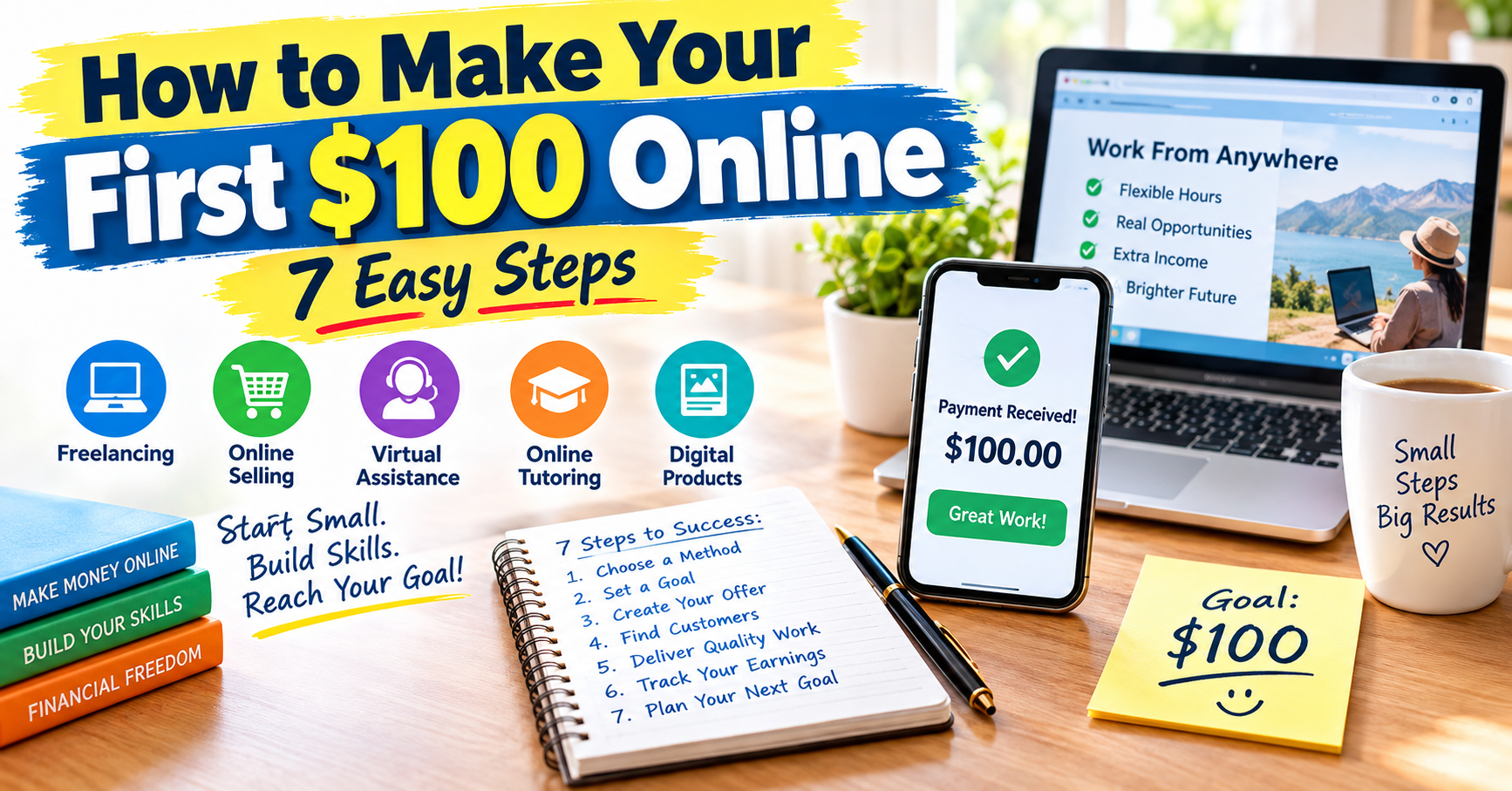
- Freelancing: Write articles, edit documents, design simple graphics, or perform administrative tasks for clients.
- Online selling: Sell unused clothing, books, electronics, household goods, or other items you own.
- Virtual assistance: Help business owners manage appointments, organize information, or answer routine customer questions.
- Online tutoring: Teach a subject you know well or provide language conversation practice.
- Simple digital services: Create original checklists, templates, presentations, or other useful digital resources.
For example, suppose you’re good at writing. You could offer to write a short blog post for a small business. If you don’t have a marketable service yet, selling unused items might be a more practical starting point.
Your first goal isn’t to find the perfect business. It’s to find a legitimate opportunity you can act on.
Action: Write down three things you can sell or do for someone else. Choose the one you can begin with the least cost and difficulty.
Step 2. Turn Your $100 Goal Into Smaller Targets
A $100 target can feel difficult when you don’t know where to begin. Breaking it into smaller amounts makes the process easier to understand. For example, you could aim to earn $25 four times, $20 five times, or $10 ten times.
Consider these sample approaches:
- Complete four small projects that pay $25 each.
- Sell five items and receive an average of $20 per item after selling costs.
- Complete ten small tasks that pay $10 each.
- Combine two or more methods if one activity doesn’t provide enough opportunities.
These are examples, not guaranteed earnings. Finding customers, completing the work, and receiving payment may take time.
Also, distinguish between revenue and profit. If you sell an item for $25 but spend $5 on shipping and fees, you haven’t kept the full $25. A simple notebook or phone spreadsheet can help you record each transaction.
Action: Choose a target, such as four $25 projects, and write down how you’ll find
the customers needed to reach it.
Step 3. Create a Simple Offer People Understand
People need to understand what you’re offering before they can decide whether to pay you. You don’t need a fancy website, professional logo, or expensive business cards to start. A clear description of your service can be enough.
For example, instead of saying, “I do online work,” describe the specific result you provide. You might say: “I help small business owners turn rough notes into clear, easy-to-read articles.” Or: “I create simple, organized budget spreadsheets to help people track their monthly expenses.”
A good offer explains what you do, who you help, and what the customer receives.
Follow these steps:
- Choose one service or product.
- Describe the problem it solves.
- State exactly what the customer will receive.
- Set a reasonable starting price based on the work involved.
- Explain the delivery time and any limits on revisions or additional work.
For example, a beginner might offer a clearly defined writing assignment for an agreed price. The price should reflect the time, skill, and effort required, rather than being chosen simply to attract anyone willing to pay.
Don’t promise results you can’t control, such as guaranteed sales, viral posts, or a specific increase in website traffic.
Action: Write a two-sentence offer and ask someone you trust whether they understand what you’re selling.
Step 4. Find Real Customers or Buyers
You can have a good service, but you won’t earn money until someone is willing to pay for it.
This is where many beginners struggle. They spend hours watching videos about making money but never offer anything to a real customer. Instead, start looking for people who may genuinely need what you provide.
Here are practical ways to begin:
- Freelance marketplaces: Explore reputable platforms such as Upwork or Fiverr, checking their current eligibility, fees, and payment rules.
- Local business outreach: Contact businesses that may benefit from writing, design, administrative, or social media services.
- Online marketplaces: List personal belongings for sale through a reputable marketplace available in your country.
- Personal networks: Tell friends, former colleagues, or community contacts about your service without pressuring them to buy.
- Relevant online communities: Participate in appropriate groups where your service is welcome, and follow their promotional rules.
For example, if you offer document formatting, a small business owner who regularly prepares reports may be a potential customer.
You don’t need to contact hundreds of people at once. Start with a few suitable prospects and personalize your message. Never send repetitive spam or pretend to have experience you don’t possess.
Action: Identify five potential buyers or customers and prepare a polite, specific message explaining how you could help.
Step 5. Deliver Quality Work and Collect Payment Safely
Once someone agrees to pay you, your job is to deliver what you’ve promised.
Confirm the price, deadline, scope of work, and payment arrangements before starting. For larger assignments, consider using a reputable platform’s payment protection or agreeing on appropriate milestones.
Follow these steps:
- Confirm the customer’s requirements in writing.
- Agree on the price and when payment is due.
- Complete the work carefully and meet the agreed deadline.
- Review the finished work before sending it.
- Keep a record of the agreement, delivery, fees, and payment.
If you’re selling physical items, describe their condition honestly and use safe payment and delivery arrangements.
Be careful with suspicious payment messages. A stranger may send a fake payment confirmation or ask you to pay a fee to release your earnings.
Never deposit a check from an unknown person and send back part of the money. A bank may initially make funds available before discovering that the check is fraudulent.
Action: Before accepting your first job or sale, decide how you’ll verify payment and keep a record of the transaction.
Step 6. Track Your Progress Until You Reach $100
Now it’s time to measure your progress. Don’t rely on memory. Record the amount earned, the expenses involved, and the money you actually receive.
Here’s a simple example:
- First project: $30 received.
- Second project: $25 received.
- Third project: $20 received.
- Fourth project: $35 received.
Total received: $110. If you incurred $10 in expenses, your amount remaining before taxes would be $100.
This example illustrates why it’s important to distinguish between money earned, money received, and profit after expenses. Your actual tax treatment may differ depending on your country and circumstances.
You can track your results in a notebook or a basic spreadsheet with these headings:
- Date.
- Product sold or service completed.
- Amount received.
- Expenses and platform fees.
- Net amount before taxes.
- Time spent.
If you aren’t making progress, examine the reason. Perhaps your offer isn’t clear, your price doesn’t match the market, or you’re contacting the wrong customers. Make one improvement at a time rather than abandoning everything immediately.
Action: Record every transaction and review your progress once a week.
Step 7. Use Your First $100 to Build Momentum
Congratulations when you reach your first $100. Even if the amount seems small, you’ve learned something valuable: you can identify an opportunity, provide something useful, and receive payment. Now decide what to do next.
You have several options:
- Build an emergency fund: Save part of the money for unexpected expenses.
- Reduce expensive debt: Consider putting some toward high-interest debt while maintaining enough cash for essential needs.
- Improve your skills: Purchase a reasonably priced learning resource only if it addresses a real skill gap and fits your budget.
- Improve your service: Use customer feedback to make your work more useful and efficient.
- Seek repeat customers: If a customer is satisfied, ask whether they need similar work in the future.
Don’t spend your first earnings on expensive software, questionable coaching programs, or a business model you don’t understand.
Suppose you earn another $100 next month. You can review your results, keep records, and decide whether the activity deserves more of your time.
The goal is not merely to reach $100 once. It’s to learn how to earn money responsibly and make informed decisions about what comes next.
Action: Choose one financial purpose for your first $100 and one practical step that could help you earn your next $100.
3. Pro Tips for Earning Your First $100 Online
3.1. Start With What You Already Have
Your existing skills, smartphone, internet connection, and unused belongings may be enough to begin. Avoid borrowing money to test an unproven online business.
3.2. Focus on Solving a Problem
Customers pay for useful results. Instead of asking only, “How can I make money?” ask, “What problem can I help someone solve?”
3.3. Keep Your First Offer Simple
A clearly defined service is easier to explain, price, and deliver than a complicated package with many promises.
3.4. Protect Your Time
Track how long each task takes. A small payment may be worthwhile for practice, but repeatedly accepting work that pays very little per hour may not be sustainable.
3.5. Be Patient With Long-Term Income Methods
Affiliate marketing, content creation, blogging, and digital products may eventually generate income, but they often require consistent effort before producing meaningful results.
If your immediate goal is to reach $100, a service or direct sale may be more straightforward than waiting for an audience to grow.
3.6. Verify Every Opportunity
Research employers, marketplaces, and payment requirements. The U.S. Federal Trade Commission provides consumer guidance on job scams at https://consumer.ftc.gov/.
3.7. Keep Income Records From Day One
Even a small amount of online income may have reporting requirements. Check the rules in your country and retain records of relevant income and expenses.
4. Frequently Asked Questions
4.1. Can I make my first $100 online with no experience?
Yes, it may be possible. Selling belongings you already own or offering a simple service based on an existing skill can be practical starting points. However, you still need to find genuine buyers or customers.
4.2. How quickly can I make $100 online?
Some people may reach the target within a few days, while others may need several weeks or longer. It depends on your method, available time, customer demand, and payment schedule.
There is no guaranteed timeline.
4.3. Can I make my first $100 online using only my phone?
Yes. You may be able to sell items, complete short freelance assignments, create simple content, or manage customer communications using a phone. Some activities are easier with a computer, so check the actual requirements.
4.4. Do I need to invest money to make $100 online?
Not necessarily. Some methods have little or no startup cost if you already have the necessary equipment and internet access. Other methods involve platform fees, materials, or business expenses.
Start with an amount you can afford to lose, and avoid borrowing money for an untested idea.
4.5. What is the easiest legitimate way to make $100 online?
There isn’t one best method for everyone. Selling unused items may be suitable if you own things people want to buy. Freelancing may work better if you have a marketable skill and can find clients.
Choose the method that fits your situation.
4.6. Can surveys help me earn my first $100?
Possibly, but survey availability and compensation vary. Some platforms pay small amounts or offer points and gift cards instead of cash. Read the payout rules and calculate how much time you spend.
4.7. Are online side hustles available in the USA, UK, Canada, and Australia?
Many opportunities are available in these countries, but each platform may have different eligibility rules, supported payment methods, and service restrictions. Check the requirements before investing your time.
4.8. Do I have to report my online earnings?
You may have tax-reporting obligations even when you earn money outside a regular job. Requirements vary by country and type of income. Check your tax authority’s official guidance or consult a qualified professional.
4.9. How can I avoid online money-making scams?
Avoid offers that guarantee high income for little work, demand suspicious upfront payments, ask you to move money for strangers, or require you to pay to unlock supposed earnings. Verify the business independently before sharing sensitive information.
4.10. What should I do after earning my first $100?
Review your expenses, save a portion if possible, and evaluate which activity produced the best results. If customers were satisfied and the work was worthwhile, consider improving your service or finding repeat clients.
5. Common Mistakes to Avoid
5.1. Trying Too Many Methods at Once
The problem: You spend your time registering for platforms but don’t complete any work.
The solution: Choose one method and test it consistently before adding another.
5.2. Buying Expensive Courses Too Early
The problem: You spend money learning how to earn money before testing whether customers want your service.
The solution: Use free educational resources first. Pay for training only when you understand what skill you need and why it’s worth the cost.
5.3. Believing Guaranteed Income Claims
The problem: Someone promises that you’ll earn $100 every day if you follow a particular system.
The solution: Treat guaranteed-income claims with skepticism and verify the opportunity independently.
5.4. Ignoring Expenses
The problem: You count every sale as profit.
The solution: Subtract relevant costs and fees before calculating how much you’ve actually made.
5.5. Accepting Unclear Work Agreements
The problem: You begin a project without agreeing on payment, deadlines, or the expected result.
The solution: Confirm the terms in writing before starting.
5.6. Giving Up After One Rejection
The problem: Your first potential customer declines, so you assume the idea won’t work.
The solution: Learn from the response, improve your offer, and approach other suitable prospects without spamming them.
5.7. Spending All Your First Earnings
The problem: You reach $100 but have nothing left to show for your effort.
The solution: Decide how you’ll use the money before spending it. Prioritize essential expenses, emergency savings, or debt reduction as appropriate for your situation.
6. Quick Actions
6.1. Today: Choose Your Method
Write down three skills, products, or services you could offer. Choose one that you can start without unnecessary spending.
6.2. Tomorrow: Prepare Your Offer
Write a short description of what you’re selling, who it helps, and what the customer will receive. Set a reasonable price and clear terms.
6.3. This Week: Contact Potential Customers
Reach out to a few suitable prospects, publish a legitimate listing, or apply for an appropriate freelance opportunity. Keep track of your responses.
6.4. This Month: Review Your Results
Calculate how much you’ve received, what you’ve spent, and how much time you’ve invested. Improve your approach based on actual results.
6.5. After Reaching $100: Plan Your Next Goal
Celebrate your progress, review your financial priorities, and decide whether to repeat the same activity or try a better opportunity.
7. Disclaimer
This article is for general educational and informational purposes only. It isn’t financial, tax, legal, employment, or business advice.
Online income varies, and earnings aren’t guaranteed. Platform availability, payment terms, fees, and legal requirements differ by country. Verify relevant information before starting an online activity.
This post may contain affiliate links. MoneyWealthGuide.com may earn a commission from qualifying purchases or sign-ups at no additional cost to you.
8. Information Sources
- U.S. Federal Trade Commission (FTC), Consumer Advice and Scam Prevention: https://consumer.ftc.gov
- U.S. Small Business Administration (SBA), Business Guidance and Resources: https://www.sba.gov
- Internal Revenue Service (IRS), Self-Employed Individuals Tax Center: https://www.irs.gov/businesses/small-businesses-self-employed/self-employed-individuals-tax-center
- UK Government, Working for Yourself: https://www.gov.uk/working-for-yourself
- HM Revenue & Customs (HMRC), Set Up as a Sole Trader: https://www.gov.uk/set-up-sole-trader
- Canada Revenue Agency (CRA), Business and Self-Employed Income: https://www.canada.ca/en/revenue-agency/services/tax/businesses/topics/sole-proprietorships-partnerships.html
- Australian Taxation Office (ATO), Business and Self-Employed Tax Information: https://www.ato.gov.au/businesses-and-organisations
- Australian Competition and Consumer Commission (ACCC), Scamwatch: https://www.scamwatch.gov.au
12 Side Hustles You Can Do on Weekends
15 Best Online Side Hustles You Can Do From Your Phone
ZERO TO WEALTHY (GROUP 1) (Table of Contents)
 Victor Sterling