
CHAPTER 16 — NEEDS VS. WANTS
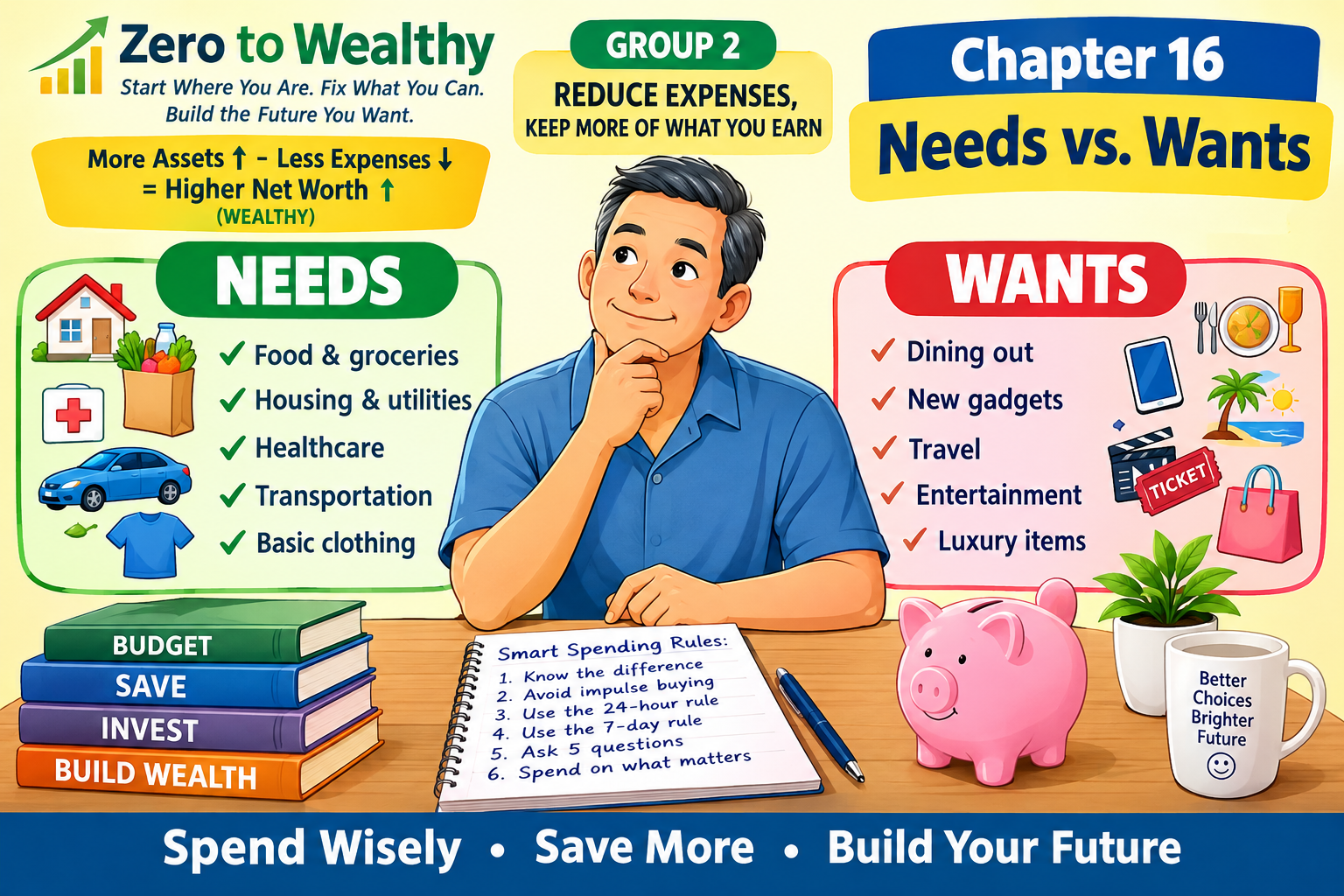
ZERO TO WEALTHY
Start Where You Are. Fix What You Can. Build the Future You Want.
More Assets ↑ – Less Expenses ↓ = Higher Net Worth ↑ (WEALTHY)
GROUP 2 — REDUCE EXPENSES, KEEP MORE OF WHAT YOU EARN
CHAPTER 16 — NEEDS VS. WANTS
Topic: 2.16.01. What Is A Financial Need?
2.16.01.1. Idea Or Explanation
A financial need is something you reasonably require to live, work, stay safe, or meet an important responsibility.
Basic needs can include food, housing, utilities, necessary transportation, appropriate clothing, insurance, and required debt payments. The exact definition of a need can differ from person to person because circumstances are different.
For example, transportation may be a need if you depend on a vehicle to get to work. However, an expensive luxury vehicle may be a want rather than a basic need.
Understanding your needs helps you protect the expenses that matter most while identifying areas where you have more flexibility.
2.16.01.2. Step-By-Step Guide
Step 1: List Your Basic Living Expenses
Write down the expenses required for your basic daily life.
Step 2: List Your Housing Cost
Include rent, mortgage, utilities, and necessary housing expenses.
Step 3: List Your Food Expenses
Separate basic food needs from optional dining and convenience purchases.
Step 4: List Necessary Transportation
Identify transportation required for work, family, and essential activities.
Step 5: List Necessary Insurance
Include appropriate insurance that protects you from significant financial risks.
Step 6: List Required Debt Payments
Record minimum required payments on debts.
Step 7: Review Healthcare-Related Costs
Consider necessary healthcare and related expenses.
Step 8: Identify Work-Related Expenses
Include reasonable costs required to earn your income.
Step 9: Separate Needs From Preferences
Ask whether each expense is truly necessary.
Step 10: Review Your Need Categories
Make sure important expenses haven’t been overlooked.
Step 11: Calculate Your Total Needs
Add your necessary expenses together.
Step 12: Compare Needs With Income
Determine how much of your income is required for basic needs.
Step 13: Look For Reasonable Savings
Find ways to reduce necessary expenses without creating problems.
Step 14: Protect Essential Needs
Don’t cut necessary expenses simply to make your budget look better.
Step 15: Review Your Needs Regularly
Your financial needs can change as your life changes.
2.16.01.3. Frequently Asked Questions
FAQ 1: Is everything I consider important a financial need?
Not necessarily. Some things can be personally important without being financially necessary.
FAQ 2: Can a need become a want?
Yes. For example, basic transportation may be a need, while a particular luxury vehicle may be a want.
FAQ 3: Should I eliminate all wants?
No. The goal is to understand the difference so you can spend intentionally.
FAQ 4: Why identify financial needs?
Knowing your needs helps you protect essential spending while controlling optional spending.
Topic: 2.16.02. What Is A Financial Want?
2.16.02.1. Idea Or Explanation
A financial want is something you would like to have but can generally live without.
Wants can include entertainment, luxury items, upgraded products, expensive restaurants, vacations, hobbies, and convenience services.
Wants aren’t automatically bad. Money is also meant to provide enjoyment and improve your quality of life. The problem begins when wants consistently consume money needed for savings, debt reduction, or other financial priorities.
The goal isn’t to eliminate wants. It’s to make sure wants fit within your financial capacity.
2.16.02.2. Step-By-Step Guide
Step 1: List Your Recent Purchases
Review what you’ve purchased recently.
Step 2: Identify Optional Purchases
Mark purchases you could have lived without.
Step 3: Separate Wants From Needs
Classify each optional expense.
Step 4: Review Entertainment Spending
Look at movies, games, hobbies, and other recreation.
Step 5: Review Restaurant Spending
Separate necessary food from optional dining.
Step 6: Review Luxury Purchases
Identify higher-cost versions of products you could purchase more cheaply.
Step 7: Review Convenience Services
Look for services that save time but cost additional money.
Step 8: Calculate Monthly Want Spending
Add your optional spending.
Step 9: Calculate Annual Want Spending
Estimate the yearly cost.
Step 10: Decide Which Wants Matter Most
Identify purchases that provide the greatest value to you.
Step 11: Create A Want-Spending Budget
Set a reasonable amount for optional spending.
Step 12: Avoid Using Debt For Unnecessary Wants
Be cautious about financing purchases that aren’t necessary.
Step 13: Keep Wants Within Your Income
Don’t allow optional spending to consume money needed for essential goals.
Step 14: Redirect Unused Want Spending
Move unspent money toward savings or another financial goal.
Step 15: Review Your Priorities
Update your wants budget as your financial situation changes.
2.16.02.3. Frequently Asked Questions
FAQ 1: Are wants bad for wealth building?
No. The issue is whether spending on wants is reasonable and fits your financial plan.
FAQ 2: Can I budget for wants?
Yes. Creating a specific amount for optional spending can make your budget more realistic.
FAQ 3: Why do wants sometimes feel like needs?
Advertising, habits, social pressure, and convenience can make optional purchases feel necessary.
FAQ 4: Should I stop buying wants until I become wealthy?
Not necessarily. A sustainable financial plan can include reasonable enjoyment while still building wealth.
Topic: 2.16.03. Why Wants Can Become Financial Problems
2.16.03.1. Idea Or Explanation
A single want usually isn’t a financial problem. Problems can develop when optional purchases become frequent, expensive, or financed with debt.
For example, buying an occasional meal at a restaurant may fit comfortably into a budget. Eating out several times a week while carrying expensive credit card debt can create a different financial situation.
Wants become particularly risky when they compete with necessities, savings, debt payments, or asset building.
2.16.03.2. Step-By-Step Guide
Step 1: Identify Your Wants
List common optional purchases.
Step 2: Track How Often You Buy Them
Frequency matters as much as price.
Step 3: Calculate The Monthly Cost
Add repeated purchases together.
Step 4: Calculate The Annual Cost
Estimate the long-term spending.
Step 5: Compare Wants With Savings
See whether optional spending is preventing you from saving.
Step 6: Compare Wants With Debt Payments
Determine whether wants are competing with debt reduction.
Step 7: Check Your Credit Card Use
See whether wants are being financed with borrowed money.
Step 8: Identify Emotional Purchases
Look for purchases made because of stress, boredom, or excitement.
Step 9: Identify Social Pressure
Notice spending influenced by friends, advertising, or trends.
Step 10: Set A Want Budget
Create a reasonable limit.
Step 11: Use Cash Or Available Funds Carefully
Avoid buying optional items you can’t reasonably afford.
Step 12: Delay Larger Purchases
Give yourself time to reconsider expensive wants.
Step 13: Redirect Some Want Spending
Move part of the money toward savings or debt reduction.
Step 14: Monitor Your Results
Review whether the changes improve your finances.
Step 15: Build Better Spending Habits
Focus on intentional spending rather than automatic spending.
2.16.03.3. Frequently Asked Questions
FAQ 1: Can small wants become a major problem?
Yes. Frequent small purchases can add up significantly.
FAQ 2: Should I avoid credit cards for wants?
Credit cards can be useful payment tools, but carrying costly balances for optional purchases can make those purchases much more expensive.
FAQ 3: Why do people overspend on wants?
Habit, convenience, advertising, social pressure, and emotions can all influence spending.
FAQ 4: How can I control want spending?
Track it, set limits, delay larger purchases, and give your savings a specific purpose.
Topic: 2.16.04. The Difference Between Necessary And Convenient
2.16.04.1. Idea Or Explanation
Something can be convenient without being necessary.
Convenience has value because it can save time and effort. The problem occurs when convenience spending becomes so frequent that it significantly increases your expenses.
For example, ordering food may be convenient, while preparing food at home may cost less. Neither choice is automatically right or wrong. The financial question is whether the convenience is worth the additional cost for you.
2.16.04.2. Step-By-Step Guide
Step 1: Identify Convenient Purchases
Look for purchases made primarily to save time or effort.
Step 2: Ask Whether The Purchase Is Necessary
Determine whether you actually need the service.
Step 3: Calculate The Additional Cost
Compare convenience with the lower-cost alternative.
Step 4: Review Food Delivery
Calculate delivery fees and higher food costs.
Step 5: Review Transportation Convenience
Consider taxis, rideshare services, parking, and other options.
Step 6: Review Household Services
Identify services you could perform yourself if appropriate.
Step 7: Review Convenience Subscriptions
Look for recurring services that aren’t essential.
Step 8: Calculate Monthly Convenience Spending
Add the costs together.
Step 9: Calculate Annual Convenience Spending
Estimate the yearly cost.
Step 10: Identify Valuable Convenience
Keep conveniences that provide meaningful value.
Step 11: Identify Low-Value Convenience
Reduce conveniences that provide little benefit.
Step 12: Set A Convenience Budget
Create a reasonable spending limit.
Step 13: Use Convenience Selectively
Reserve it for situations where it provides real value.
Step 14: Track The Savings
Measure how much you save by reducing convenience spending.
Step 15: Redirect The Savings
Use saved money for a financial goal.
2.16.04.3. Frequently Asked Questions
FAQ 1: Is convenience spending always bad?
No. Convenience can have real value, especially when time is limited.
FAQ 2: How do I decide whether convenience is worth the cost?
Compare the additional cost with the time, effort, and value you receive.
FAQ 3: Should I do everything myself to save money?
No. Your time has value too. Choose carefully where doing something yourself makes sense.
FAQ 4: Can convenience spending affect wealth building?
Yes. Repeated convenience costs can reduce the amount available for saving and investing.
Topic: 2.16.05. The 24-Hour Purchase Rule
2.16.05.1. Idea Or Explanation
The 24-hour purchase rule is a simple method for slowing down impulse spending. When you want to purchase a nonessential item, wait at least 24 hours before buying it. During that time, the emotional excitement of the purchase may decrease.
After waiting, you can ask whether you still want the item and whether it fits your budget.
The rule doesn’t need to apply to every purchase. It’s most useful for optional purchases that you weren’t planning to make.
2.16.05.2. Step-By-Step Guide
Step 1: Identify An Unplanned Purchase
Notice when you’re about to buy something unexpectedly.
Step 2: Determine Whether It’s A Need
If it isn’t necessary, consider waiting.
Step 3: Record The Price
Write down the full cost.
Step 4: Start The 24-Hour Clock
Wait at least one full day.
Step 5: Don’t Purchase During The Waiting Period
Give yourself time to think.
Step 6: Ask Why You Want It
Identify the reason behind the purchase.
Step 7: Check Your Budget
Determine whether you have room for the purchase.
Step 8: Consider Your Existing Items
Ask whether you already own something that serves the same purpose.
Step 9: Compare Prices
Look for alternatives if you still want the item.
Step 10: Consider The Long-Term Value
Think about how often you’ll use it.
Step 11: Consider The Opportunity Cost
Ask what else the money could accomplish.
Step 12: Review Your Emotions
Determine whether stress, boredom, excitement, or pressure influenced the decision.
Step 13: Make A Deliberate Decision
Choose whether the purchase still makes sense.
Step 14: Record The Outcome
Track purchases you delayed or avoided.
Step 15: Make The Rule A Habit
Use the 24-hour pause whenever appropriate.
2.16.05.3. Frequently Asked Questions
FAQ 1: Does the 24-hour rule apply to everything?
No. It’s mainly useful for nonessential or unplanned purchases.
FAQ 2: What if the item is on sale?
A sale doesn’t automatically make an unnecessary purchase affordable. Consider the total cost and whether you need the item.
FAQ 3: What if I still want the item after 24 hours?
If it fits your budget and remains a worthwhile purchase, you can make a deliberate decision.
FAQ 4: Can waiting really reduce spending?
It can help because it creates time between the desire to buy and the actual purchase.
Topic: 2.16.06. The 7-Day Rule For Larger Purchases
2.16.06.1. Idea Or Explanation
Larger purchases deserve more time and consideration than small purchases.
The 7-day rule means waiting approximately seven days before making a significant nonessential purchase. The exact dollar amount that qualifies as “large” should depend on your income and budget.
A week gives you time to compare prices, review your budget, consider alternatives, and decide whether the purchase is truly worthwhile.
2.16.06.2. Step-By-Step Guide
Step 1: Identify A Large Purchase
Determine whether the purchase is significant relative to your finances.
Step 2: Record The Total Cost
Include taxes, fees, accessories, maintenance, and other related costs.
Step 3: Ask Whether It’s A Need
Determine whether you actually need it.
Step 4: Start The Seven-Day Waiting Period
Give yourself time before purchasing.
Step 5: Research Alternatives
Look for competing products or services.
Step 6: Compare Prices
Check several reasonable options.
Step 7: Review Your Budget
Make sure the purchase fits comfortably.
Step 8: Consider Paying Cash
If appropriate, determine whether you can afford it without expensive borrowing.
Step 9: Consider The Long-Term Cost
Look beyond the initial purchase price.
Step 10: Consider How Often You’ll Use It
Estimate its practical value.
Step 11: Review Your Existing Alternatives
Determine whether something you already own can do the job.
Step 12: Identify Emotional Influences
Ask whether excitement or social pressure is affecting the decision.
Step 13: Reconsider After Seven Days
Decide whether you still want the item.
Step 14: Make A Deliberate Decision
Buy only if the purchase still makes sense.
Step 15: Record What You Learned
Notice whether waiting helped you make better decisions.
2.16.06.3. Frequently Asked Questions
FAQ 1: What qualifies as a large purchase?
It depends on your income and financial situation. A useful rule is to treat purchases that could materially affect your budget as large.
FAQ 2: Why seven days?
A week provides more time to research, compare, and reconsider the purchase.
FAQ 3: Does this rule apply to necessary purchases?
Not always. Necessary purchases may need to be made sooner.
FAQ 4: What if the price changes during the waiting period?
That’s possible. But a discount shouldn’t pressure you into buying something you don’t need or can’t reasonably afford.
Topic: 2.16.07. Avoid Emotional Spending
2.16.07.1. Idea Or Explanation
Emotional spending happens when feelings influence a purchase more than a thoughtful financial decision.
Stress, boredom, sadness, excitement, frustration, loneliness, and even celebration can trigger spending.
The purchase may provide temporary satisfaction, but the financial consequences can last much longer.
Learning to recognize emotional spending can help you separate a genuine financial decision from an emotional reaction.
2.16.07.2. Step-By-Step Guide
Step 1: Notice Your Emotional State
Pay attention to how you’re feeling before shopping.
Step 2: Identify Spending Triggers
Look for situations that repeatedly lead to unnecessary purchases.
Step 3: Record Emotional Purchases
Write down purchases connected to strong emotions.
Step 4: Identify The Pattern
Determine when and why the behavior occurs.
Step 5: Pause Before Buying
Give yourself time before making optional purchases.
Step 6: Use The 24-Hour Rule
Delay smaller nonessential purchases.
Step 7: Use The Seven-Day Rule
Delay larger nonessential purchases.
Step 8: Find A Non-Spending Alternative
Take a walk, call someone, read, rest, or use another healthy activity.
Step 9: Review Your Budget
Remind yourself of your financial priorities.
Step 10: Remove Easy Spending Triggers
Unsubscribe from unnecessary promotional messages and remove stored payment information when appropriate.
Step 11: Avoid Shopping When Highly Emotional
Wait until you’re calmer before making optional purchases.
Step 12: Create A Planned Fun Budget
Allow reasonable spending so the system doesn’t feel excessively restrictive.
Step 13: Track Your Progress
Record emotional purchases you successfully avoided.
Step 14: Redirect The Money
Move saved money toward a financial goal.
Step 15: Review Your Pattern Monthly
Look for improvement and recurring triggers.
2.16.07.3. Frequently Asked Questions
FAQ 1: Why do emotions affect spending?
Shopping can provide temporary excitement, comfort, or relief, which can influence financial decisions.
FAQ 2: Does emotional spending mean something is wrong with me?
No. Many people experience emotional influences on spending. The useful step is recognizing the pattern and creating safeguards.
FAQ 3: What can I do instead of emotional shopping?
Choose another activity that provides enjoyment or relief without creating unnecessary financial costs.
FAQ 4: Should I completely stop shopping when emotional?
Avoiding optional purchases until you’re in a calmer state can help you make more deliberate decisions.
Topic: 2.16.08. Avoid Impulse Buying
2.16.08.1. Idea Or Explanation
Impulse buying is purchasing something without adequate planning or consideration.
It can happen in physical stores, online, through social media, or when limited-time promotions create pressure to buy immediately.
Impulse buying becomes a financial problem when repeated purchases consume money that could have been used for more important purposes.
A pause between seeing something and buying it can make a major difference.
2.16.08.2. Step-By-Step Guide
Step 1: Recognize Impulse Purchases
Notice purchases you didn’t plan before shopping.
Step 2: Create A Shopping List
Know what you’re shopping for before you begin.
Step 3: Avoid Browsing Without A Purpose
Unplanned browsing can create unnecessary temptation.
Step 4: Use The 24-Hour Rule
Wait before buying smaller nonessential items.
Step 5: Use The Seven-Day Rule
Wait before buying larger nonessential items.
Step 6: Compare Prices
Don’t assume the first price is the best available option.
Step 7: Check Your Budget
Make sure the purchase fits.
Step 8: Ask Whether You Already Own Something Similar
Avoid unnecessary duplication.
Step 9: Review The Product’s Usefulness
Determine how often you’ll realistically use it.
Step 10: Calculate The Total Cost
Include accessories, fees, maintenance, and other costs.
Step 11: Ignore Artificial Urgency
Be cautious when promotions pressure you to buy immediately.
Step 12: Remove Stored Payment Information
Adding a small amount of friction can make impulse purchases less automatic.
Step 13: Track Purchases You Avoid
Record money you kept by waiting.
Step 14: Redirect Saved Money
Move it toward savings, debt reduction, or asset building.
Step 15: Make Delayed Buying Your Normal Habit
Turn thoughtful purchasing into a routine.
2.16.08.3. Frequently Asked Questions
FAQ 1: Why is impulse buying dangerous?
Repeated unplanned purchases can consume money without providing lasting value.
FAQ 2: Does every impulse purchase hurt my finances?
Not necessarily. One small purchase may have little effect, but repeated impulse spending can become significant.
FAQ 3: How can I stop online impulse buying?
Use shopping lists, waiting periods, price comparisons, and fewer saved payment details.
FAQ 4: What should I do when I successfully avoid an impulse purchase?
Consider redirecting the money toward a financial goal.
Topic: 2.16.09. Ask The Five Questions Before Buying
2.16.09.1. Idea Or Explanation
Before making a purchase, five simple questions can help you slow down and think.
- Do I need it?
- Can I afford it?
- Do I already have something similar?
- Will I use it enough to justify the cost?
- What else could this money do?
These questions don’t tell you what decision to make. They help you make the decision deliberately.
2.16.09.2. Step-By-Step Guide
Step 1: Ask, “Do I Need It?”
Determine whether the purchase is necessary.
Step 2: Ask, “Can I Afford It?”
Check your available budget.
Step 3: Ask, “Do I Already Own Something Similar?”
Avoid unnecessary duplication.
Step 4: Ask, “Will I Use It Enough?”
Estimate the practical value.
Step 5: Ask, “What Else Could This Money Do?”
Consider savings, debt reduction, or investing.
Step 6: Write Down Your Answers
Writing can make the decision more deliberate.
Step 7: Check The Full Price
Include taxes, fees, and related costs.
Step 8: Compare Alternatives
Look for reasonable alternatives.
Step 9: Check Your Spending Plan
Make sure the purchase fits your current priorities.
Step 10: Consider Waiting
Use the 24-hour or seven-day rule when appropriate.
Step 11: Review Emotional Influences
Determine whether emotions are affecting your decision.
Step 12: Review Long-Term Value
Think about how useful the purchase will be over time.
Step 13: Make Your Decision
Decide intentionally rather than automatically.
Step 14: Record Significant Purchases
Keep a record of larger decisions.
Step 15: Learn From Your Results
Review whether your purchases provided the value you expected.
2.16.09.3. Frequently Asked Questions
FAQ 1: Why use five questions before buying?
They create a simple pause that encourages thoughtful spending.
FAQ 2: Do I need to ask all five questions for every purchase?
Not necessarily. They are especially useful for optional or significant purchases.
FAQ 3: What if I need something immediately?
Necessary purchases may require immediate action. The questions are mainly useful when you have a choice.
FAQ 4: Can these questions help with online shopping?
Yes. They can be especially useful when online shopping makes purchasing fast and easy.
Topic: 2.16.10. Spend On What Matters Most
2.16.10.1. Idea Or Explanation
Expense control isn’t about spending as little as possible. It’s about directing your money toward what matters most.
Some expenses may provide significant value to your life. Others may provide little value despite costing a lot.
Once you understand your needs and wants, you can make better decisions about where your money belongs.
The goal is to spend intentionally, avoid waste, protect your financial priorities, and keep enough money available to build assets and increase net worth.
2.16.10.2. Step-By-Step Guide
Step 1: Identify Your Financial Priorities
Write down the things that matter most financially.
Step 2: Identify Your Personal Priorities
Consider the people, activities, and experiences that matter most to you.
Step 3: Review Your Current Spending
Compare your spending with those priorities.
Step 4: Identify Spending That Adds Real Value
Keep expenses that genuinely support your priorities.
Step 5: Identify Low-Value Spending
Find expenses that don’t contribute much to your goals.
Step 6: Separate Needs From Wants
Make sure essential expenses are protected.
Step 7: Create A Priority Spending List
Rank your major financial priorities.
Step 8: Create A Wants Budget
Allow room for reasonable enjoyment.
Step 9: Set A Savings Target
Reserve money for future needs and opportunities.
Step 10: Set A Debt-Reduction Target
Direct appropriate funds toward expensive or high-priority debt.
Step 11: Set An Asset-Building Target
Reserve money for investments or other productive assets when appropriate.
Step 12: Review Large Purchases Carefully
Make sure major purchases support your priorities.
Step 13: Review Small Purchases
Prevent small spending from quietly consuming your budget.
Step 14: Review Your Plan Monthly
Compare actual spending with your priorities.
Step 15: Keep Improving Your Spending Decisions
Use what you learn to make future spending more intentional.
2.16.10.3. Frequently Asked Questions
FAQ 1: Does spending on what matters mean spending more money?
Not necessarily. It means directing the money you already have toward the things that provide the greatest value to you.
FAQ 2: Can I spend money on entertainment?
Yes. Entertainment can be part of a healthy spending plan when it fits your budget and priorities.
FAQ 3: How do I know what matters most financially?
Consider your essential needs, financial goals, responsibilities, and long-term priorities.
FAQ 4: What is the connection between intentional spending and wealth building?
Intentional spending can help you keep more of your income available for savings, debt reduction, investing, and asset building.
Chapter 16 Lesson
Every purchase is a choice about where your money goes. Some purchases are needs. Some are wants. Some are conveniences. Some are emotional or impulsive decisions.
The goal isn’t to make you feel guilty about spending money. The goal is to help you become more aware of your decisions.
Before buying, pause. Ask whether you need it. Ask whether you can afford it. Ask whether you already own something similar. Ask whether you’ll use it enough. Then ask what else the money could accomplish.
For smaller optional purchases, consider the 24-hour rule.
For larger optional purchases, consider the 7-day rule.
These simple pauses can create space between wanting something and actually buying it.
Remember the ZERO TO WEALTHY principle: You don’t have to stop spending. You need to stop spending money without a purpose.
When you spend intentionally, you can enjoy the money you earn while keeping more available for savings, debt reduction, investments, and productive assets.
Zero To Wealthy Principle: Know Your Needs. Control Your Wants. Avoid Impulse Spending. Spend On What Matters. Keep More Of What You Earn.
Disclaimer
This ebook is provided for educational and informational purposes only. The ideas in this chapter are general financial-management concepts and aren’t personalized financial, investment, tax, legal, or accounting advice.
Your financial situation may be different from the examples discussed. Your income, expenses, family responsibilities, debt, taxes, financial goals, and personal circumstances should be considered before making financial decisions.
The 24-hour and 7-day purchase rules are voluntary budgeting techniques, not universal requirements. Necessary purchases may require quicker decisions, while some purchases may require additional research and consideration.
Before making significant financial, investment, debt, business, tax, or legal decisions, consider consulting an appropriately qualified professional who can evaluate your individual circumstances.
© 2026 Victor Sterling / MoneyWealthGuide.com. All rights reserved.
This material is provided for personal online reading and educational purposes. Reproduction, redistribution, or publication of this material without permission is not permitted.
CHAPTER 15 — UNDERSTAND WHERE YOUR MONEY GOES