
CHAPTER 15 — UNDERSTAND WHERE YOUR MONEY GOES
© 2026 Victor Sterling / MoneyWealthGuide.com. All rights reserved.
This material is provided for personal online reading and educational purposes. Reproduction, redistribution, or publication of this material without permission is not permitted.
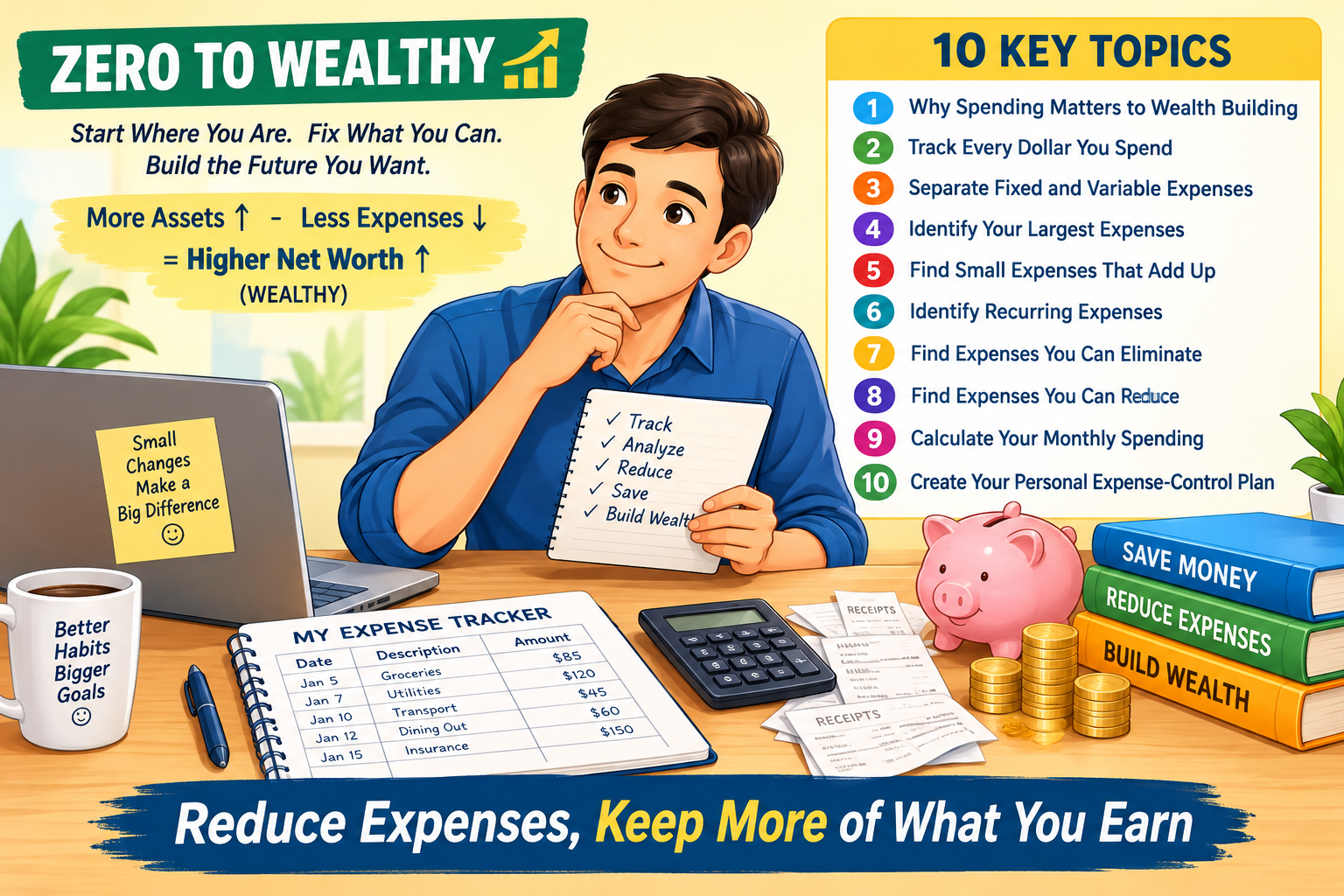
ZERO TO WEALTHY
Start Where You Are. Fix What You Can. Build the Future You Want.
More Assets ↑ – Less Expenses ↓ = Higher Net Worth ↑ (WEALTHY)
GROUP 2 — REDUCE EXPENSES, KEEP MORE OF WHAT YOU EARN
CHAPTER 15 — UNDERSTAND WHERE YOUR MONEY GOES
Topic: 2.15.01. Why Spending Matters To Wealth Building
2.15.01.1. Idea Or Explanation
Income is only one part of wealth building. What you do with that income matters just as much. If you earn more money but spend nearly all of it, your financial position may not improve very much.
Every dollar has a job. Money can pay for necessities, provide enjoyment, reduce debt, build savings, or purchase assets. Your spending decisions determine how much money remains available for those other purposes.
Think of your income as water flowing into a container. Your expenses are the holes where the water flows out. If too much water escapes, there isn’t much left to build your financial future.
Reducing unnecessary spending doesn’t mean eliminating everything you enjoy. The goal is to spend intentionally. You want to know where your money is going and decide whether each expense supports your current needs, personal priorities, or long-term goals.
When you control expenses, you create more room for savings, debt reduction, investing, and asset building. That’s why spending control is an important part of the ZERO TO WEALTHY strategy.
2.15.01.2. Step-By-Step Guide
Step 1: Calculate Your Monthly Income
Add up your regular take-home income so you know how much money is available.
Step 2: Review Your Current Spending
Look at your recent bank, credit card, and cash transactions.
Step 3: List Your Major Expenses
Write down housing, transportation, food, insurance, debt payments, and other major costs.
Step 4: List Your Smaller Expenses
Include subscriptions, snacks, coffee, entertainment, delivery fees, and other small purchases.
Step 5: Separate Needs From Wants
Identify expenses required for basic living and expenses that are optional.
Step 6: Identify Your Spending Patterns
Look for repeated habits that cause money to leave your account.
Step 7: Find Your Biggest Expense Categories
Determine which categories consume the largest portions of your income.
Step 8: Review Your Debt Payments
See how much of your income goes toward credit cards, loans, and other debt.
Step 9: Review Your Subscriptions
Check whether you’re paying for services you rarely use.
Step 10: Look For Unnecessary Fees
Identify bank fees, late fees, convenience charges, and other avoidable costs.
Step 11: Set A Spending Limit
Create reasonable limits for categories where spending has become excessive.
Step 12: Protect Essential Expenses
Make sure necessary housing, food, utilities, insurance, and transportation costs are covered.
Step 13: Redirect Savings
Decide where money saved from expense reductions will go.
Step 14: Track Your Progress
Compare your spending each month with your previous spending.
Step 15: Turn Spending Control Into A Habit
Continue reviewing your expenses regularly instead of treating expense control as a one-time project.
2.15.01.3. Frequently Asked Questions
FAQ 1: Why does spending matter if I have a good income?
A high income can provide more opportunities, but excessive spending can consume much of that income. Wealth building depends partly on what you keep and how you use it.
FAQ 2: Do I have to stop spending money on entertainment?
No. The goal isn’t to eliminate everything you enjoy. The goal is to make sure entertainment spending fits within your overall financial plan.
FAQ 3: Should I focus on reducing small expenses first?
Small expenses can help, but large expenses often have a bigger effect on your budget. Review both large and small expenses.
FAQ 4: What should I do with money I save by reducing expenses?
You might use it to build emergency savings, pay down expensive debt, invest, or purchase productive assets, depending on your situation.
Topic: 2.15.02. Track Every Dollar You Spend
2.15.02.1. Idea Or Explanation
You can’t effectively control spending if you don’t know where your money is going.
Tracking every dollar doesn’t mean you have to create a complicated accounting system. A notebook, spreadsheet, budgeting app, or simple list can work.
The purpose is awareness. A few dollars spent here and there may not seem significant. But repeated purchases can become hundreds of dollars over a month and thousands over a year.
Tracking gives you facts instead of guesses. Once you know your actual spending, you can make better decisions about what to keep, reduce, or eliminate.
2.15.02.2. Step-By-Step Guide
Step 1: Choose A Tracking Method
Use a notebook, spreadsheet, app, or other method you’ll actually use.
Step 2: Record Your Starting Balance
Write down the amount currently available in your checking and spending accounts.
Step 3: Record Every Purchase
Enter every purchase, including small cash purchases.
Step 4: Record Automatic Payments
Include bills that are automatically deducted.
Step 5: Record Credit Card Purchases
Track credit card spending when the purchase occurs, not only when the bill arrives.
Step 6: Record Cash Withdrawals
Write down what you withdraw and what you spend it on.
Step 7: Categorize Each Expense
Assign expenses to categories such as housing, food, transportation, and entertainment.
Step 8: Track Irregular Expenses
Include annual insurance, repairs, gifts, taxes, and other occasional costs.
Step 9: Review Your Records Weekly
Spend a few minutes checking that your records are complete.
Step 10: Correct Missing Transactions
Fill in expenses you forgot to record.
Step 11: Add Category Totals
Calculate how much you spent in each category.
Step 12: Calculate Your Total Spending
Add all expense categories together.
Step 13: Compare Spending With Income
Determine how much income remains after spending.
Step 14: Identify Problem Areas
Look for categories where spending is consistently higher than planned.
Step 15: Continue Tracking Monthly
Make tracking a permanent part of your financial routine.
2.15.02.3. Frequently Asked Questions
FAQ 1: Do I really need to track small purchases?
Yes. Small purchases can become significant when repeated frequently.
FAQ 2: How long should I track my expenses?
Track them continuously if possible. At minimum, tracking for several months can reveal useful spending patterns.
FAQ 3: Can I track expenses manually?
Yes. A simple notebook or spreadsheet can work very well.
FAQ 4: What is the biggest benefit of expense tracking?
It gives you a clear picture of how you actually use your money.
Topic: 2.15.03. Separate Fixed And Variable Expenses
2.15.03.1. Idea Or Explanation
Not every expense behaves the same way. Fixed expenses are generally predictable from month to month. Examples may include rent or mortgage payments, insurance premiums, and certain loan payments.
Variable expenses can change from month to month. Food, gasoline, entertainment, clothing, and household purchases may fall into this category.
Separating the two helps you understand where you have flexibility. Fixed expenses may require longer-term decisions, while variable expenses can sometimes be adjusted more quickly.
2.15.03.2. Step-By-Step Guide
Step 1: List All Monthly Expenses
Write down every regular expense.
Step 2: Identify Fixed Expenses
Mark expenses that generally remain stable.
Step 3: Identify Variable Expenses
Mark expenses that change from month to month.
Step 4: Review Your Housing Cost
Determine whether housing is fixed and how much of your income it consumes.
Step 5: Review Transportation Costs
Separate regular payments from changing fuel, maintenance, and transportation costs.
Step 6: Review Food Spending
Separate regular grocery needs from restaurant and convenience purchases.
Step 7: Review Insurance Costs
Identify your regular insurance premiums.
Step 8: Review Debt Payments
Separate required debt payments from optional extra payments.
Step 9: Calculate Fixed Expenses
Add all fixed expenses together.
Step 10: Calculate Variable Expenses
Add all variable expenses together.
Step 11: Compare The Two Totals
See which category represents more of your spending.
Step 12: Identify Flexible Expenses
Find variable expenses that you can reasonably adjust.
Step 13: Review Fixed Commitments
Consider whether some fixed expenses can eventually be changed.
Step 14: Create Spending Limits
Set reasonable limits for flexible categories.
Step 15: Review The Classification Monthly
Update your list when expenses change.
2.15.03.3. Frequently Asked Questions
FAQ 1: Is a mortgage payment a fixed expense?
Generally, the required principal and interest payment is relatively predictable, although taxes, insurance, or other costs may change.
FAQ 2: Is food a fixed or variable expense?
Food is generally a variable expense because the amount spent can change.
FAQ 3: Why separate fixed and variable expenses?
It helps you identify which expenses are easier to adjust.
FAQ 4: Can a variable expense become fixed?
Yes. For example, you might create a regular monthly grocery budget even though actual food spending can vary.
Topic: 2.15.04. Identify Your Largest Expenses
2.15.04.1. Idea Or Explanation
Your largest expenses deserve special attention because small changes in major categories can have a meaningful effect on your finances.
Housing, transportation, debt payments, insurance, and food may represent large portions of many household budgets.
The goal isn’t automatically to eliminate your largest expense. Some large expenses are necessary. Instead, ask whether the cost is reasonable for your income and whether there are practical ways to reduce it.
2.15.04.2. Step-By-Step Guide
Step 1: List Your Top Ten Expenses
Start with your largest monthly expenses.
Step 2: Rank Them By Cost
Put the largest expenses at the top.
Step 3: Calculate Your Housing Cost
Include major housing-related expenses.
Step 4: Calculate Transportation Costs
Include payments, fuel, insurance, parking, and maintenance.
Step 5: Calculate Food Costs
Include groceries, restaurants, delivery, and convenience purchases.
Step 6: Calculate Debt Payments
Add required payments on credit cards and loans.
Step 7: Calculate Insurance Costs
Include major insurance premiums.
Step 8: Calculate Utility Costs
Review electricity, water, internet, telephone, and similar services.
Step 9: Review Your Largest Category
Ask whether the expense is necessary and reasonable.
Step 10: Look For Lower-Cost Alternatives
Compare practical alternatives.
Step 11: Avoid Cutting Essential Protection Carelessly
Don’t eliminate important insurance or necessary services simply to save money.
Step 12: Set A Reduction Target
Choose an amount you believe you can reasonably reduce.
Step 13: Make One Change At A Time
Test practical changes instead of trying to change everything at once.
Step 14: Measure The Savings
Record the actual amount saved.
Step 15: Redirect The Savings
Use the savings for a financial purpose rather than immediately spending it elsewhere.
2.15.04.3. Frequently Asked Questions
FAQ 1: Should I always reduce my largest expense first?
Not necessarily. The best target depends on whether the expense is necessary, flexible, and realistically reducible.
FAQ 2: What are common large expenses?
Housing, transportation, food, debt payments, insurance, and utilities are common major categories.
FAQ 3: Can reducing one large expense make a big difference?
Yes. A modest monthly reduction in a major expense can add up over a year.
FAQ 4: Should I focus only on large expenses?
No. Review large expenses and smaller recurring expenses together.
Topic: 2.15.05. Find Small Expenses That Add Up
2.15.05.1. Idea Or Explanation
Small expenses are easy to ignore because each purchase may seem insignificant.
A $5 purchase doesn’t look like a major financial decision. But spending $5 repeatedly can become more than $150 per month if it happens every day.
The lesson isn’t that every small purchase is bad. The lesson is that repeated spending deserves attention.
2.15.05.2. Step-By-Step Guide
Step 1: Review Small Purchases
Look through your recent transactions.
Step 2: Identify Repeated Purchases
Look for purchases that happen several times each week.
Step 3: Add Daily Purchases Together
Calculate the monthly total.
Step 4: Review Coffee And Snacks
Determine how much these purchases cost each month.
Step 5: Review Delivery Fees
Add delivery charges and service fees.
Step 6: Review Convenience Purchases
Identify items purchased mainly because they’re convenient.
Step 7: Review Entertainment Spending
Add smaller entertainment purchases.
Step 8: Review Digital Subscriptions
Check subscriptions you rarely use.
Step 9: Calculate Annual Costs
Multiply recurring monthly costs by twelve.
Step 10: Identify Your Least Valuable Purchases
Find spending that provides little value.
Step 11: Choose A Few Expenses To Reduce
Don’t try to eliminate everything.
Step 12: Set A Weekly Limit
Create a reasonable limit for discretionary purchases.
Step 13: Redirect The Savings
Move saved money toward savings or another financial goal.
Step 14: Monitor Your Results
Check your spending after several weeks.
Step 15: Keep The Changes That Work
Continue habits that save money without making your life unnecessarily difficult.
2.15.05.3. Frequently Asked Questions
FAQ 1: Can small expenses really affect wealth building?
Yes. Repeated small expenses can become substantial over months and years.
FAQ 2: Should I eliminate every small purchase?
No. Focus on purchases that don’t provide enough value for their cost.
FAQ 3: What is a good place to start?
Start with repeated purchases you don’t really need or enjoy.
FAQ 4: What should I do with the money I save?
Give the savings a specific purpose, such as emergency savings, debt reduction, or investing.
Topic: 2.15.06. Identify Recurring Expenses
2.15.06.1. Idea Or Explanation
Recurring expenses are payments that happen repeatedly, such as subscriptions, memberships, insurance premiums, software services, and automatic bills.
They can be difficult to notice because they may be automatically charged without requiring a new decision each month.
A recurring expense isn’t necessarily a bad expense. The problem occurs when you’re paying for something you no longer use or need.
2.15.06.2. Step-By-Step Guide
Step 1: Review Your Bank Statements
Look for repeated charges.
Step 2: Review Credit Card Statements
Identify recurring charges appearing on your cards.
Step 3: List Every Subscription
Write down each subscription service.
Step 4: List Memberships
Include clubs, gyms, websites, and other memberships.
Step 5: List Automatic Bills
Include recurring household and service payments.
Step 6: Record The Monthly Cost
Write down the cost of each recurring expense.
Step 7: Calculate Annual Cost
Multiply monthly costs by twelve.
Step 8: Ask Whether You Still Use It
Review the value you receive.
Step 9: Identify Unused Services
Mark services you rarely or never use.
Step 10: Cancel Unnecessary Services
Cancel subscriptions you no longer need.
Step 11: Review Duplicate Services
Look for multiple services that perform similar functions.
Step 12: Consider Lower-Cost Options
Compare less expensive alternatives where appropriate.
Step 13: Check Renewal Dates
Know when annual subscriptions renew.
Step 14: Record Your Savings
Calculate how much you saved by eliminating unnecessary recurring costs.
Step 15: Review Recurring Expenses Every Few Months
Repeat the process regularly.
2.15.06.3. Frequently Asked Questions
FAQ 1: Why are recurring expenses easy to overlook?
Automatic payments can continue without requiring you to actively make a purchase each month.
FAQ 2: Should I cancel all subscriptions?
No. Keep services that provide meaningful value and fit your budget.
FAQ 3: How often should I review subscriptions?
Review them every few months and before major annual renewals.
FAQ 4: Can recurring expenses become a major problem?
Yes. Many small recurring charges can add up to a substantial annual amount.
Topic: 2.15.07. Find Expenses You Can Eliminate
2.15.07.1. Idea Or Explanation
Some expenses provide little or no value and can be eliminated completely.
These might include unused subscriptions, duplicate services, unnecessary fees, impulse purchases, or purchases that no longer fit your priorities.
Eliminating an expense is different from reducing it. If you can remove the expense entirely, the full amount becomes available for another purpose.
2.15.07.2. Step-By-Step Guide
Step 1: Review Your Spending Records
Start with actual spending information.
Step 2: List Optional Expenses
Identify expenses that aren’t required.
Step 3: Identify Unused Services
Find subscriptions or memberships you don’t use.
Step 4: Identify Duplicate Services
Look for services that overlap.
Step 5: Identify Avoidable Fees
Review bank, late, delivery, and convenience fees.
Step 6: Identify Impulse Purchases
Look for purchases made without planning.
Step 7: Identify Low-Value Spending
Find purchases that provide little satisfaction or usefulness.
Step 8: Mark Expenses For Elimination
Create a short list.
Step 9: Cancel What You Don’t Need
Take action rather than simply identifying the expense.
Step 10: Avoid Replacing The Expense
Don’t immediately substitute another unnecessary expense.
Step 11: Calculate Monthly Savings
Add the eliminated expenses.
Step 12: Calculate Annual Savings
Multiply recurring monthly savings by twelve.
Step 13: Redirect The Money
Move the savings toward a financial goal.
Step 14: Monitor Your Behavior
Make sure the eliminated expenses don’t return.
Step 15: Repeat The Review
Search for additional unnecessary expenses periodically.
2.15.07.3. Frequently Asked Questions
FAQ 1: What expense should I eliminate first?
Start with an expense that provides little value and is easy to remove.
FAQ 2: Should I eliminate entertainment spending?
Not necessarily. Keep reasonable spending that provides genuine value and fits your plan.
FAQ 3: What if I can’t eliminate a necessary expense?
Look for ways to reduce the cost instead.
FAQ 4: Where should eliminated expenses go?
Give the money a purpose, such as savings, debt reduction, or asset building.
Topic: 2.15.08. Find Expenses You Can Reduce
2.15.08.1. Idea Or Explanation
Not every expense can be eliminated. Some expenses are necessary but may have room for adjustment.
You may be able to reduce grocery costs, utility usage, transportation expenses, insurance costs, service plans, or entertainment spending without eliminating them completely.
The target is to lower costs while maintaining a reasonable quality of life.
2.15.08.2. Step-By-Step Guide
Step 1: Identify Flexible Expenses
Find expenses where the amount can change.
Step 2: Choose One Category
Start with one area rather than changing everything.
Step 3: Review Recent Spending
Determine your normal monthly cost.
Step 4: Set A Lower Target
Choose a realistic reduction.
Step 5: Compare Prices
Look for less expensive alternatives.
Step 6: Reduce Unnecessary Usage
Use less of expensive resources where practical.
Step 7: Shop With A Plan
Avoid unnecessary purchases.
Step 8: Compare Service Plans
Check whether a lower-cost plan meets your needs.
Step 9: Review Insurance Costs
Compare available options carefully while maintaining appropriate coverage.
Step 10: Reduce Food Waste
Use food more efficiently and plan purchases.
Step 11: Reduce Convenience Spending
Prepare ahead when doing so makes financial sense.
Step 12: Monitor The New Spending Level
Track the category after making changes.
Step 13: Calculate Actual Savings
Compare old spending with new spending.
Step 14: Redirect The Difference
Use the savings for a specific financial purpose.
Step 15: Repeat With Another Category
Once one category is under control, review another.
2.15.08.3. Frequently Asked Questions
FAQ 1: Is reducing expenses better than eliminating them?
It depends on the expense. Some costs can be reduced while others can be eliminated.
FAQ 2: Should I always choose the cheapest option?
No. Consider quality, reliability, usefulness, and total cost.
FAQ 3: How much should I try to reduce an expense?
Choose an amount that is realistic and sustainable.
FAQ 4: What should I do with the savings?
Redirect the money toward savings, debt reduction, investing, or another financial goal.
Topic: 2.15.09. Calculate Your Monthly Spending
2.15.09.1. Idea Or Explanation
You need a clear monthly spending number before you can create an effective expense-control plan.
Your monthly spending includes more than the bills you remember paying each month. It can include groceries, transportation, subscriptions, insurance, debt payments, entertainment, household purchases, and irregular expenses.
Knowing your actual monthly spending allows you to compare expenses with income and determine how much money is available for savings and wealth building.
2.15.09.2. Step-By-Step Guide
Step 1: Gather Your Financial Records
Collect bank statements, credit card statements, receipts, and payment records.
Step 2: Choose A Review Period
Start with the most recent month.
Step 3: List Housing Expenses
Record rent, mortgage, utilities, and other housing costs.
Step 4: List Transportation Expenses
Include payments, fuel, maintenance, insurance, and transportation services.
Step 5: List Food Expenses
Include groceries, restaurants, delivery, and other food purchases.
Step 6: List Debt Payments
Record credit card and loan payments.
Step 7: List Insurance Costs
Include regular insurance payments.
Step 8: List Personal Expenses
Include clothing, healthcare-related spending, grooming, and other personal expenses.
Step 9: List Entertainment Expenses
Record recreation, hobbies, and entertainment purchases.
Step 10: List Subscriptions
Add recurring digital and physical subscriptions.
Step 11: Include Irregular Expenses
Account for expenses that don’t occur every month.
Step 12: Add All Categories
Calculate total spending.
Step 13: Compare Spending With Income
Subtract total spending from monthly take-home income.
Step 14: Identify The Remaining Amount
Determine how much money remains available for savings, debt reduction, or investing.
Step 15: Repeat The Calculation Monthly
Use the same process to monitor changes.
2.15.09.3. Frequently Asked Questions
FAQ 1: What if my spending changes every month?
Track several months and calculate an average to get a more useful picture.
FAQ 2: Should savings be counted as an expense?
For budgeting purposes, many people treat savings as a planned allocation of income rather than an expense. The key is to track it consistently.
FAQ 3: Should credit card purchases be counted?
Yes. Count the purchase when it occurs so your spending isn’t hidden until the credit card bill is paid.
FAQ 4: Why calculate monthly spending?
It helps you understand how much income is being consumed and how much remains for financial goals.
Topic: 2.15.10. Create Your Personal Expense-Control Plan
2.15.10.1. Idea Or Explanation
Once you understand where your money goes, the next step is to create a personal expense-control plan.
A good plan doesn’t require you to stop enjoying life. It gives your money direction.
Your plan can identify expenses to eliminate, expenses to reduce, spending limits for flexible categories, and the amount you want to redirect toward savings, debt reduction, investing, or asset building.
The objective is simple: keep more of what you earn and give the money you keep a useful job.
2.15.10.2. Step-By-Step Guide
Step 1: Calculate Your Monthly Take-Home Income
Start with the income you actually receive.
Step 2: Calculate Your Current Monthly Spending
Use your expense records.
Step 3: Identify Your Largest Expenses
Determine which categories consume the most money.
Step 4: Identify Unnecessary Expenses
Create a list of expenses you can eliminate.
Step 5: Identify Reducible Expenses
Create a second list of expenses you can lower.
Step 6: Set Spending Limits
Create reasonable limits for flexible categories.
Step 7: Protect Essential Expenses
Make sure necessary expenses remain covered.
Step 8: Set A Monthly Savings Target
Decide how much you want to keep from each month’s income.
Step 9: Set A Debt-Reduction Target
If you have debt, determine how much additional money can reasonably go toward it.
Step 10: Set An Asset-Building Target
Determine how much money can eventually be directed toward productive assets or investments.
Step 11: Create A Weekly Spending Check
Review your spending at least once each week.
Step 12: Review Your Monthly Results
Compare actual spending with your targets.
Step 13: Correct Problems Quickly
If a category exceeds its limit, make adjustments rather than ignoring it.
Step 14: Redirect Your Savings
Make sure money saved through expense control isn’t simply spent somewhere else.
Step 15: Review And Improve Your Plan
Update your plan as your income, expenses, and financial goals change.
2.15.10.3. Frequently Asked Questions
FAQ 1: What is an expense-control plan?
It’s a personal system for monitoring, reducing, and directing your spending so more of your income can support your financial goals.
FAQ 2: Does an expense-control plan mean I can’t enjoy my money?
No. It means you decide intentionally how much money to spend and where to spend it.
FAQ 3: How often should I review my plan?
A weekly spending check and a more complete monthly review can help keep the plan on track.
FAQ 4: What should happen to money saved through expense control?
Give it a specific purpose, such as emergency savings, debt reduction, investing, or acquiring productive assets.
Chapter 15 Lesson
Your money has a direction whether you choose that direction or not. Every dollar you earn eventually becomes a spending decision, a debt payment, savings, or an asset. That’s why understanding where your money goes is one of the foundations of wealth building.
Start by tracking your spending. Separate fixed expenses from variable expenses. Identify your largest expenses. Then look for small expenses, recurring expenses, unnecessary expenses, and expenses that can be reduced.
You don’t have to change everything overnight. Start with one expense. Reduce it. Keep the savings. Give that money a new job. Then move to the next expense.
The goal of Group 2 is not simply to spend less. The goal is to keep more of what you earn so you have more money available to build your financial future.
Disclaimer
This ebook is for educational and informational purposes only. The examples and strategies are general ideas for managing income and expenses and aren’t personalized financial, investment, tax, legal, or accounting advice.
Your financial situation, income, expenses, debts, taxes, family responsibilities, and goals may be different from those described in this chapter. Consider your own circumstances before making financial decisions.
Expense reductions should be reasonable and shouldn’t require you to neglect essential needs, appropriate insurance, necessary healthcare, debt obligations, or other important responsibilities.
Before making major financial, investment, business, tax, or debt decisions, consider consulting a qualified professional who can evaluate your individual situation.