AFFILIATE DISCLOSURE
MoneyWealthGuide.com may earn a commission when you click certain links and purchase or sign up for products or services recommended on this website. This doesn’t affect the price you pay and helps support the maintenance of this website.
By Victor Sterling | Last updated: October 21, 2026 | Rates reviewed: mid-October 2026
Quick note: This article is general education, not financial advice. Interest rates and account terms change often, so confirm the details with the bank before you open anything. Full disclaimer at the bottom.
Picking a savings account can feel strangely confusing. Savings account, money market account, CD, cash management account: they all sound alike, and they all promise to “grow your money.”
Here’s the simple truth: the type of account you choose matters almost as much as the bank you choose. According to FDIC data reported in 2026, the average savings account pays only about 0.38% APY, the average money market account about 0.63%, and the average one-year CD about 1.71%. Meanwhile, the best online savings accounts have been paying roughly 4% to 5% APY this fall.
So the goal of this guide is simple. We’ll walk you through 8 types of savings accounts in plain English, tell you who each one fits best, and help you match the right account to each of your money goals.
First, a 30-Second Savings Vocabulary Lesson
A few terms come up over and over, so let’s clear them up:
1. APY (Annual Percentage Yield): The total interest you’d earn in one year, including compounding. Higher is better.
2. FDIC insurance: Government-backed protection for your deposits at a bank, up to $250,000 per depositor, per bank, per ownership category. Credit unions have similar protection through the NCUA.
3. Variable rate: A rate that can change at any time. Most savings and money market accounts work this way.
4. Fixed rate: A rate locked in for a set time. CDs work this way.
5. Liquidity: How easily you can get your money. A savings account is very liquid. A CD is less liquid.
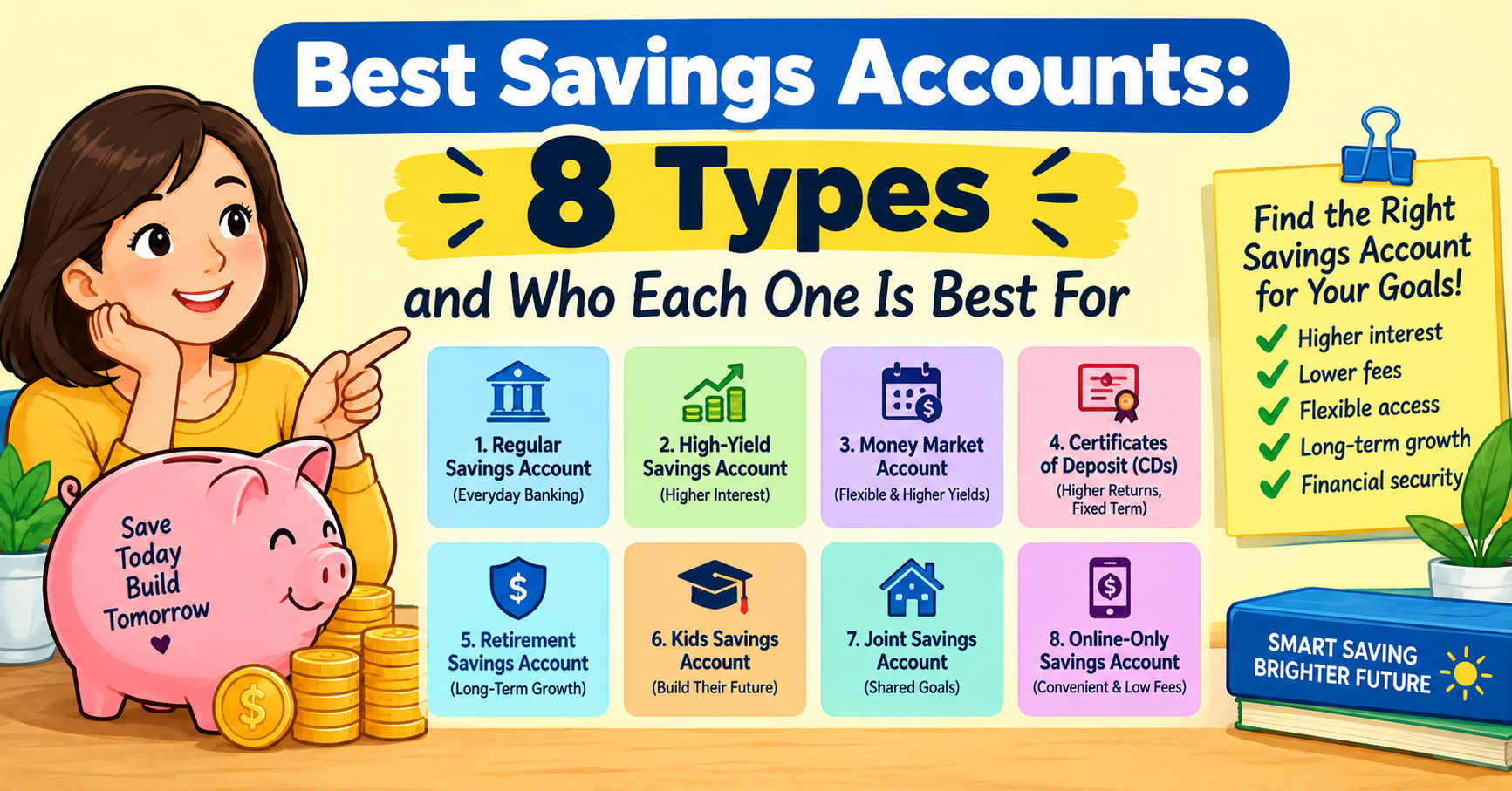
8 Types of Savings Accounts (and Who Should Use Each)
1. High-Yield Savings Account: Best for most people
This is the go-to choice for emergency funds and short-term goals. It works just like a regular savings account but pays far more, often around 4% to 5% APY at the top online banks right now.
Good for: Emergency funds, vacation money, a car or house down payment, anyone who wants easy access.
Watch out for: Variable rates that can drop, promotional rates that expire, and withdrawal limits some banks set.
2. Traditional Savings Account: Best for convenience only
This is the basic savings account at a big bank with branches. It’s convenient if you want everything under one roof, but the interest is usually tiny, often near or below the 0.38% national average.
Good for: Small balances you want right next to your checking account, or people who prefer in-person service.
Watch out for: Low rates and monthly fees that can be waived only if you keep a certain balance.
3. Money Market Account: Best if you want check-writing or a debit card
A money market account (MMA) is a hybrid. It earns interest like a savings account, but often comes with a debit card or checks. The national average rate is low (around 0.63%), but online banks sometimes offer much better rates.
Good for: A larger cushion you might need to spend from, like a home-repair fund.
Watch out for: Higher minimum balances at some banks, and fees if your balance dips too low. Don’t confuse it with a money market mutual fund, which is an investment and not FDIC-insured.
4. Certificate of Deposit (CD): Best for money you won’t touch
With a CD, you agree to leave your money at the bank for a set time (like 6 months, 1 year, or 5 years). In return, you get a fixed rate that doesn’t change. Top CD rates have recently been up to around 4.5% APY, though the average one-year CD is much lower.
Good for: Money you know you won’t need until a specific date, or people who want to lock in today’s rate in case rates fall.
Watch out for: Early withdrawal penalties. If you take your money out before the term ends, you’ll usually lose some interest.
5. No-Penalty CD: Best for a CD with an escape hatch
A no-penalty (or “liquid”) CD lets you withdraw your money early without paying a penalty, usually after a short waiting period. The rate is often slightly lower than a standard CD, but you keep your flexibility.
Good for: People who want a fixed rate but aren’t 100% sure they won’t need the money.
Watch out for: Rules vary. Some require you to take out the entire balance, not just part of it.
6. Cash Management Account: Best for people who also invest
Offered by brokerage firms and fintech apps, these accounts hold your cash, pay interest, and often come with checks and debit cards. They’re handy if you want savings and investments in the same app.
Good for: People who already invest and want everything in one place.
Watch out for: Insurance works differently here. Many of these accounts spread your money across partner banks to provide FDIC coverage. Read how your cash is protected before you deposit.
7. Credit Union Savings Account: Best for community-minded savers
Credit unions are member-owned nonprofits. They often charge lower fees and can offer friendly rates. Deposits are insured by the NCUA, which is similar to FDIC coverage, up to $250,000.
Good for: People who like local, personal service and don’t mind meeting membership rules (like where you live or work).
Watch out for: Rates can be lower than top online banks, and the app may be less polished.
8. Kids’ or Teen Savings Account: Best for teaching money habits
These accounts are set up with a parent or guardian. They’re great for helping young people learn to save, watch their balance grow, and understand interest.
Good for: Allowance, birthday money, and first jobs.
Watch out for: Rules on who owns the account and when control passes to the child. Also check for monthly fees, which can drain small balances fast.
Quick Comparison
1. High-yield savings: about 4% to 5% APY at top online banks. High access. Best for emergency funds and short-term goals.
2. Traditional savings: often under 0.5%. High access. Best for convenience.
3. Money market: about 0.6% average, higher online. High access, with check or debit options. Best for larger cushions.
4. CD: fixed rate, top rates around 4.5%. Low access until maturity. Best for money you won’t need soon.
5. No-penalty CD: fixed rate, a bit lower than regular CDs. Medium access. Best for a flexible fixed rate.
6. Cash management: varies. High access. Best for savers who also invest.
7. Credit union savings: varies. High access. Best for local, member-focused banking.
8. Kids’ savings: varies. Parent-controlled. Best for teaching saving.
Rates shown are general ranges based on mid-October 2026 reporting. Check each bank for current numbers.
Which Account Matches Which Goal?
Sometimes it’s easier to start with your goal and work backward:
1. “I need an emergency fund.” A high-yield savings account. Aim for three to six months of basic expenses.
2. “I’m saving for something in the next year or two.” A high-yield savings account or a short-term CD.
3. “I have money I definitely won’t touch for 1 to 5 years.” A CD, so you can lock in a fixed rate.
4. “I want to earn interest but still write checks.” A money market account.
5. “I want to teach my kid to save.” A kids’ or teen savings account.
6. “I’m saving for retirement 20+ years away.” A savings account isn’t usually the main tool. Look at retirement accounts like a 401(k) or IRA, and talk to a professional.
A Simple 3-Bucket Savings Plan
Not sure how to organize it all? Try this easy setup:
1. Bucket 1: Safety net. Three to six months of expenses in a high-yield savings account. Don’t touch it unless it’s a real emergency.
2. Bucket 2: Goals. Money for planned things, like a trip or a down payment, in a second high-yield account or a short CD. Many banks let you nickname accounts so you can see what’s for what.
3. Bucket 3: Locked-in savings. Money you won’t need for a while in a CD, to lock a rate.
Keep a small buffer in checking so you’re not constantly transferring money around.
How To Choose The Right Bank: 7-Point Checklist
1. FDIC or NCUA insured? This is a must. Verify it on the official FDIC or NCUA websites.
2. Real APY. Look past “up to” rates and ask what you’d actually earn.
3. Fees. The best savings accounts have no monthly fee and no minimum to earn the top rate.
4. Minimum deposit. Many good accounts need $0 to start. Don’t overpay for a feature you won’t use.
5. Transfer speed. One to three business days is normal. Make sure that fits your needs.
6. Customer support. Phone, chat, or email? Check before you need help.
7. Rate history. Some banks raise rates slowly but cut them fast. Reviews and rate trackers can help.
5 Mistakes That Cost Savers Money
1. Leaving everything at your “default” bank.
Convenience is nice, but when the difference is 0.38% versus 4%, it adds up fast. On $10,000, that’s roughly $360 a year.
2. Locking money into a CD you might need.
Early withdrawal penalties can wipe out your interest.
3. Chasing teaser rates.
A high rate that falls after a few months isn’t really high.
4. Going over insurance limits.
FDIC and NCUA coverage is capped at $250,000 per depositor, per institution, per ownership category.
5. Forgetting the tax bill.
Interest is taxable income. Your bank will send a 1099-INT in most cases, so set a little aside.
Frequently Asked Questions
What is the best type of savings account for most people?
For everyday savings and emergency funds, a high-yield savings account is the best fit for most people because it balances a strong rate with easy access.
Is a CD better than a high-yield savings account?
Not always. A CD can lock in a rate, which helps if rates fall. A high-yield savings account gives you flexibility. Many people use both.
How much money should I keep in savings?
A common guideline is three to six months of essential expenses in an emergency fund, plus separate savings for upcoming goals.
Can I have more than one savings account?
Yes. Many people use several to separate goals. Just watch for monthly fees.
Are savings account rates going to drop?
They can. Most savings rates are variable and tend to follow the Federal Reserve’s moves. No one can predict exactly what will happen, which is one reason people use CDs to lock in a rate.
The Bottom Line
The best savings account isn’t one-size-fits-all. For most people, a high-yield savings account is the easiest and most useful place to start. From there, you can add a CD for money you won’t touch, or a money market account if you want more spending flexibility.
Pick one account type that fits your next goal, compare two or three banks, and open it this week. Your future self will thank you.
Disclaimer
This article is for general informational and educational purposes only. It is not financial, tax, investment, or legal advice, and it is not a recommendation to open or use any specific account or institution.
Interest rates, fees, and terms change frequently and may differ from what is shown here. Averages and ranges are drawn from public reporting in 2026 and may not reflect current numbers.
Always verify details with the financial institution and consider consulting a qualified financial professional about your situation.
Sources and References
1. FDIC, National Rates and Rate Caps, and deposit insurance information: fdic.gov
2. NCUA, share insurance information: ncua.gov
3. SavingAdvice.com, “The FDIC Says the Average Savings Account Pays Just 0.38%,” Sept. 9, 2026 (national savings, money market and 12-month CD averages)
4. NerdWallet, “Average Bank Interest Rates for Savings Accounts, CDs and More”: nerdwallet.com
5. Fortune Recommends, “Best savings account rates” (September 2026 editions), including CD rate ranges: fortune.com
6. MoneyRates.com, “The best savings accounts of September 2026”: moneyrates.com
7. The College Investor, “Best High-Yield Savings Rates for October 14, 2026”: thecollegeinvestor.com
8. IRS, interest income and Form 1099-INT: irs.gov
Over a career of more than 40 years, Victor worked as a bookkeeper, casino auditor, systems analyst, financial analyst, and assistant controller for casinos and real estate companies in Las Vegas, Nevada. Along the way, he lived and applied the 12 cores of personal finance, including money management, banking and savings, loans and debt management, real estate investing, stocks and bonds, and taxation. These were not just textbook ideas to him. They were lessons tested in real life.
Best High-Yield Savings Accounts 2026: 7 Options Worth Comparing
How To Use Online And Mobile Banking Safely: 15 Tips To Protect Your Money
 Victor Sterling